 CimpactPRO Partner
Türkçeye Geç
CimpactPRO Partner
Türkçeye Geç
 Danışma Hattı
0 (850) 346 33 11
Danışma Hattı
0 (850) 346 33 11
 CimpactPro CORP
Corporate Carbon Footprint Calculation and Reporting Software.
CimpactPro CBAM
Border Carbon Regulatory Mechanism (CCRM) Declaration Software.
CimpactPro ESG
Sustainability / ESG Reporting and Management Software. (GRI)
CimpactPro CITY
Emissions Management and Reporting Software for Cities and Municipalities (GPC)
CimpactPro is a sustainability software family that covers all sectors with its modular structure developed by taking into account the specific needs of different sectors.
Explore All Sectors


With our mentoring, training and research-analysis packages, we build your capacity, finalize processes together and link your decisions to data-based, measurable results.
All Services
Accelerate standards compliance with weekly/monthly coaching and increase your teams' success in error-free implementation and on-time delivery.
Get Detailed Information
With hands-on sessions, it adapts standards and regulations to your corporate data; makes competence permanent and enables rapid implementation.
Get Detailed Information
Green maturity, awareness and GAP measurements link decisions to data and clarify the priority roadmap and KPIs.
Get Detailed InformationFrom technical guides to expert opinions, from analysis of current legislation to software support tools, CimpactPro Resources library has all the information you need to take firm steps towards your sustainability goals.


Kozyatağı Mah. İbrahim Ağa Sk. Som Plaza Kat:5 Kadıköy/İstanbul/TÜRKİYE
What is the Carbon Cycle?
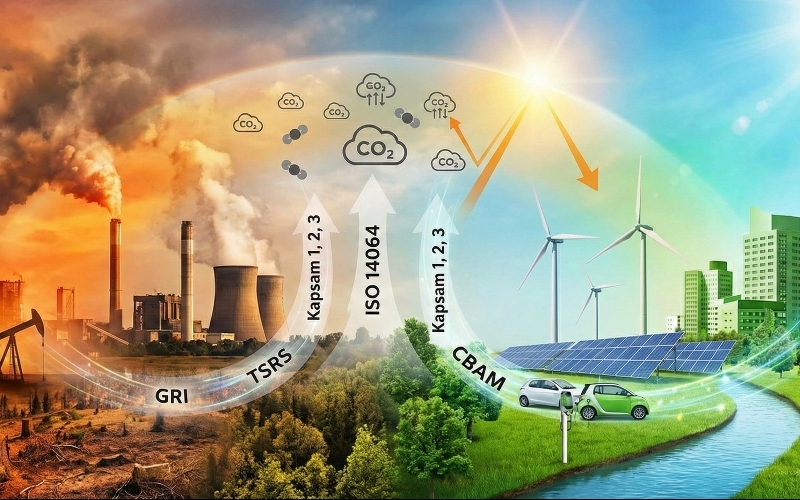


How does it happen in nature?
Important Note: Your sources do not contain scientific data supporting the definition of the carbon cycle, its stages or its natural functioning. The content below explains the relevance of "carbon" in the context of corporate sustainability and emissions management.
How Does the Carbon Cycle Work?
In the context of corporate sustainability, the impact of companies on the carbon cycleis realized through greenhouse gas emissions (carbon footprint). To manage this impact, companies adopt corporate carbon footprintingas the first step towards environmental sustainability.
What are the Impacts of the Carbon Cycle on Nature?
The purpose and scope of environmental sustainability for organizations is about measuring, reducing and increasing resilience to the environmental impacts of their operations. These impacts include the distribution of emissions as Scope 1, 2 and 3. Environmental impacts also include impacts on water footprint, waste management and biodiversity.
What is the Human Impact on the Carbon Cycle?
Greenhouse gas emissions (GHG) from human activities create critical risks for companies. These risks include threats such as physical climate risks (drought, extreme weather events) and regulatory costs (e.g. SDCC/CBAM) that threaten financial sustainability.
Managing human impact aims to decouple the organization's growth from environmental degradation, which means economic activity with lower carbon emissions and less resource intensity.
Why is Carbon Cycle Management Necessary for Organizations?
Corporate carbon footprint calculation and emissions management is not only an environmental responsibility, but also a financial and legal obligation. This management underpins the Environmental (E) dimension of the ESGF (Environmental, Social, Governance and Financial Sustainability) framework.
The necessity of stewardship is based on the following factors:
Legal Compliance and Obligation: There is a Border Carbon Adjustment Mechanism (CBAM) reporting obligation for in-scope sectors exporting to the EU (iron and steel, cement, aluminum, fertilizer, hydrogen, electricity). The CBAM Module enables the calculation and reporting of embedded emissions (SEE) in the XML format required by the EU Commission to meet this legal obligation.
Risk Management: Financial threats such as environmental risks (carbon cost sensitivity) and regulatory costs (SDCC/CBAM) need to be managed.
Competition and Access to Finance: Promoting products with a low carbon footprint facilitates access to green financing sources. Investor Relations also demands transparency standards such as GRI Reporting.
Strategies to Reduce Carbon Footprint
Emissions reductions are achieved by following a roadmap, usually starting with the Corporate Carbon Footprint (ISO 14064-1) module.
The main mitigation strategies and practices are as follows:
Inventory and Verification Preparation: Inventory of the organization's greenhouse gas emissions as Scope 1, 2 and 3 in accordance with the ISO 14064-1 standard. This requires setting up a MRV (Monitoring, Reporting, Verification) system ahead of the verification obligation starting in 2026. The CimpactPro platform can be used to manage this process, eliminating the risk of using the wrong factor.
Financial Integration: Use of a carbon cost shadow price to account for environmental costs in investment decisions.
Product Level Mitigation: Reducing the environmental impact of products and gaining competitive advantage by conducting Product Carbon Footprinting (ISO 14067) or Life Cycle Analysis (LCA).
Carbon Reporting and ESG Compliance Processes
Corporate emissions data is reported to comply with international standards and regulations.
Standards: The main standards used for reporting include ISO 14064-1, GHG Protocol and GRI (Global Reporting Initiative). GRI is one of the oldest standards focused on providing transparency to stakeholders.
Mandatory Compliance: The EU's CSRD (Corporate Sustainability Reporting Directive) and ESRS standards emphasize the principle of dual materiality (financial materiality and impact materiality) and require companies to report their environmental impacts. In Turkey, the Public Oversight Authority (POA) issued the Turkish Sustainability Reporting Standards (TSRS), which are close to the EU and ISSB standards. These standards require large Turkish companies to report ESG information.
Technological Governance: Platforms such as CimpactPro integrate CBAM and Corporate Carbon Footprinting processes, reducing the reporting burden for organizations and securing the audit trail.